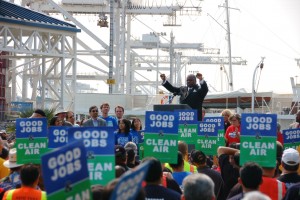
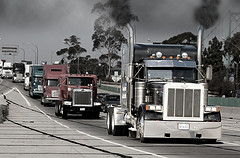
Assembly Bill (AB) 950, the Truck Driver Employment and Public Safety Protection Act, easily cleared the California State Assembly’s Labor and Employment Committee Wednesday afternoon. Assembly Speaker John Pérez (D-Los Angeles) and Assemblyman Sandré Swanson (D-Alameda), the committee chair, introduced the legislation to curb widespread illegal sub-contracting, known as “employee misclassification” in the port trucking industry.
Twenty-one year port trucking veteran Manuel Rivas, who previously worked for a major West Coast trucking company called Shippers Transport that is half owned by Goldman Sachs, exposed the shameless misclassification scheme at CA ports by delivering a powerful testimony to the committee hearing.
“It was very important for me to go to Sacramento to let the state politicians know about the port truck driver reality in California,” stated Manuel Rivas. “Thousands of drivers across the state have already signed petitions demanding our employee rights. We are employees who have been denied our rights. It is time to stop these injustices.”
The testimony by Manuel affirms what the nation’s leading employment law experts have recently published in a new report titled The Big Rig: Poverty, Pollution, and the Misclassification of Truck Drivers at America’s Ports. Port drivers like Manuel are vulnerable to illegal employment classification schemes that subject them to low non-negotiable wages, frequent safety violations, and little autonomy from the employers who dictate their financial constraints.
The passage of AB-950 would place California at the forefront of ending the misclassification swindle taking place at ports nationwide. AB 950 now moves for consideration to the full State Assembly.
From Wall Street to the America’s ports, working families can’t catch a break from tax cheating corporations – and a top-ranking California Assemblymember calls them out in an op-ed in this week’s Oakland Tribune, while highlighting legislation aimed at taking the “trickery out of trucking.”
The already notorious Goldman Sachs - who received $800 billion from the Federal Reserve and U.S. Treasury Department but only paid 1.1% of its 2008 income in taxes after raking in $2.3 billion in profit - also has its tentacles wrapped around port truck drivers and their families. The infamous firm owns half of Seattle-based SSA Marine, a transportation outfit that owns major port terminals in the United States and around the world and runs one of the largest trucking companies in California and the West Coast.
And since the apple doesn’t fall far from the tree, it’s no wonder that while Goldman Sachs was forcing working families out of their homes during the mortgage meltdown, port trucking companies like SSA were driving port truckers into bankruptcy and foreclosures. By using illegal sub-contracting, known as “employee misclassification,” these companies not only dodge taxes but they also sidestep basic corporate responsibility towards public safety. Currently truck drivers lack fundamental employee protections including the ability to report safety concerns - like the use of faulty equipment to move hazardous loads through public streets - without suffering retaliation or termination.
The concern over the impact on both workers and public safety recently reached our state’s capital when Assembly Speaker John Pérez and Assemblyman Sandré Swanson introduced AB 950, the Truck Driver Employment and Public Safety Protection Act. AB 950 would specifically require port truck drivers to be treated as employees of the trucking or shipping companies who arrange for or engage these workers’ services, so they will be protected under California’s workplace and safety laws.
To curb tax dodging in the port economy and improve public and worker safety, Assemblymember Swanson, who is also the Chair of the Assembly Committee on Labor and Employment, used Tax Week to highlight the legislation. In the op-ed, Swanson points out that “Drivers mislabeled as “independent contractors” are paid low, nonnegotiable wages and are denied protections and benefits that most workers receive from their employers including workers’ compensation, disability, Social Security and the minimum wage. Meanwhile, the companies skirt state and federal payroll taxes.”
Swanson ends his op-ed by sending a clear and strong message: “Gaming the system, Goldman Sach’s Wall Street style is not welcome at our trade hubs, one of the state’s most valuable economic engines.” AB 950 is expected to be heard on May 4th in the State Capitol.
So what is the magical formula for running a “profitable” port trucking company? According to a 20 year-old “CEO,” of an LA based port-trucking company, it’s quite simple. You cut corners on rent, sidestep clean truck laws, avoid owning a fleet, refuse to recognize drivers as employees, and dodge payroll taxes. Meet the new boss, same as the old boss: Francisco Franco, CEO of Franco Trucking.
The young “executive” conveniently headquartered out of his parents’ home in Carson, CA was recently profiled in a Daily Breeze article where he openly expresses his disdain for labor laws and contempt for the award-winning Clean Truck Program. Roughly half of the company’s drivers haul cargo in dirty Class 7 trucks—the industry’s loophole to avoid clean air regulations. These polluting rigs were never banned from the terminals but after local residents and environmental justice groups protested, the ports amended their ban. Class 7s will be barred on July 1st.
But instead of making headway into full compliance Franco seems to be scratching his head and wondering why his company can’t continue using old polluting Class 7 Trucks! Never mind that local neighborhoods are being poisoned, Franco’s only concern is how to push his workers (who even he admits can’t afford a new rigs) to buy the new trucks that Franco Trucking needs to the keep doing his business as usual.
Some boss! While Mr. Franco claims he “treats his workers with respect,” he disguises them as “independent contractors” to shirk responsibility for basic employer obligations. (Like, workers’ compensation and a guaranteed minimum wage.)
Franco Trucking is the prime example of what economists and academics have described as the “race to the bottom” in our nation’s ports. Without the typical overhead costs like employee payroll taxes, vehicle maintenance, or even the rental of an office space, companies like Franco Trucking can easily underbid legitimate competitors by underpaying their workers. Without much money in their pockets, workers are left with expensive truck maintenance that they can’t afford and in time the once new shiny (and heavily subsidized) trucks begin to run on black fumes and then ta-da: the cycle of poverty and pollution continues to plague our ports.
It’s exactly because irresponsible actors can so easily enter the market that makes full implementation and enforcement of the Los Angeles Clean Truck Program so important.
His age does not give him a free pass from corporate responsibility, please visit the article and let Mr. Franco know exactly how you feel by posting on the comments page: http://www.dailybreeze.com/news/ci_17814218?source=rv
“Stop the Attack on Working Families!” demanded one sign. “Our Communities, Our Jobs!” stated another. And “Organize!” was the call to action scrawled across a massive black and yellow Teamster banner.
The theme of worker power filled the streets of downtown Los Angeles, from the port truck drivers, environmentalists and port community activists marching near the front of the parade to hotel workers, teachers, laborers and grocery store workers in contingents marching a mile deep.
After the march through downtown, labor leaders, workers and union supporters took to the stage at Pershing Square Park, where Rage Against the Machine guitarist Tom Morello introduced Jimmy Martinez, a port truck driver from Los Angeles, to a crowd of thousands.
“The work that I and thousands of my fellow port truck drivers do is dangerous and it is hard, back-breaking work. But we do it because we are workers!” said Jimmy Martinez. “We work long hours because we love our families…but the fruit our hard work is being stolen by a greedy industry that wants us to work without employee rights. The war on workers is here and port truck drivers are uniting to win respect for all workers!”
The Coalition for Clean & Safe Ports marched in solidarity with Teamsters members and carried the names of nearly 1,500 clean ports activists from around the country that couldn’t be there in person, but asked to be there in spirit.
Will Cantrell is as proud of the work he performs to keep America’s economy moving as he is appalled at the conditions his industry creates for him and his co-workers.
Like most port drivers, Will is called an “independent contractor.” But he is prohibited from hauling for more than one company, he told USA Today, which reported on the widespread scam to cheat on taxes and rob workers of basic protections. Will’s company deducts $1,200 a month from his paycheck for use of their truck and pays him non-negotiable rates. On average, he puts up another $800 weekly for fuel and insurance. His paychecks are always a surprise, and usually disappointing after a 57-60 hour workweek.
So Will appeared at the last Oakland Port meeting. He asked commissioners, how can you let this industry I have trained for, invested in, and dedicated my life to systematically short-change the men and women who help make it profitable?
A fellow 25-year truck driver then detailed findings of a new three-port survey and analysis. Longer Hours, Lower Wages & Little Hopeisthe first snapshot of drivers’ economic outlook since industry crippled U.S. ports’ efforts to set new environmental and operational standards to clean up the sector. Oakland officials were tight-lipped after learning 25% of their drivers had declared bankruptcy, been evicted and/or foreclosed on since operating a new or retrofitted truck. In contrast, LA Harbor Commissioners couldn’t stop asking questions after a recent similar presentation.
Will revealed how he makes ends meet: Forgo the dream of having a family. The 38-year-old has deemed himself an ineligible bachelor, for having a wife and children under these financial circumstances would be “irresponsible.” He gave up his own apartment and lives with three roommates to keep expenses down.
But a resolute Will vowed to transform his industry rather than quit it. He is determined to regain collective bargaining rights in port trucking. In the meantime, he wore a homemade shirt with the words “End Sweatshops on Wheels” for the occasion.

 Assembly Bill (AB) 950, the Truck Driver Employment and Public Safety Protection Act, easily cleared the California State Assembly’s Labor and Employment Committee Wednesday afternoon. Assembly Speaker John Pérez (D-Los Angeles) and Assemblyman Sandré Swanson (D-Alameda), the committee chair, introduced the legislation to curb widespread illegal sub-contracting, known as “employee misclassification” in the port trucking industry.