
FOR IMMEDIATE RELEASE: May 2, 2009
CONTACT: Valerie Lapin, 650-455-3300
Enviro-Community-Labor Coalition Says Oakland Port Truck Plan Falls Short: Trucking Industry Legal Challenge to Air Clean-Up Has Dire Public Health Consequences
Residents & Drivers Voice Dissatisfaction & March Out of Port Meeting in Protest
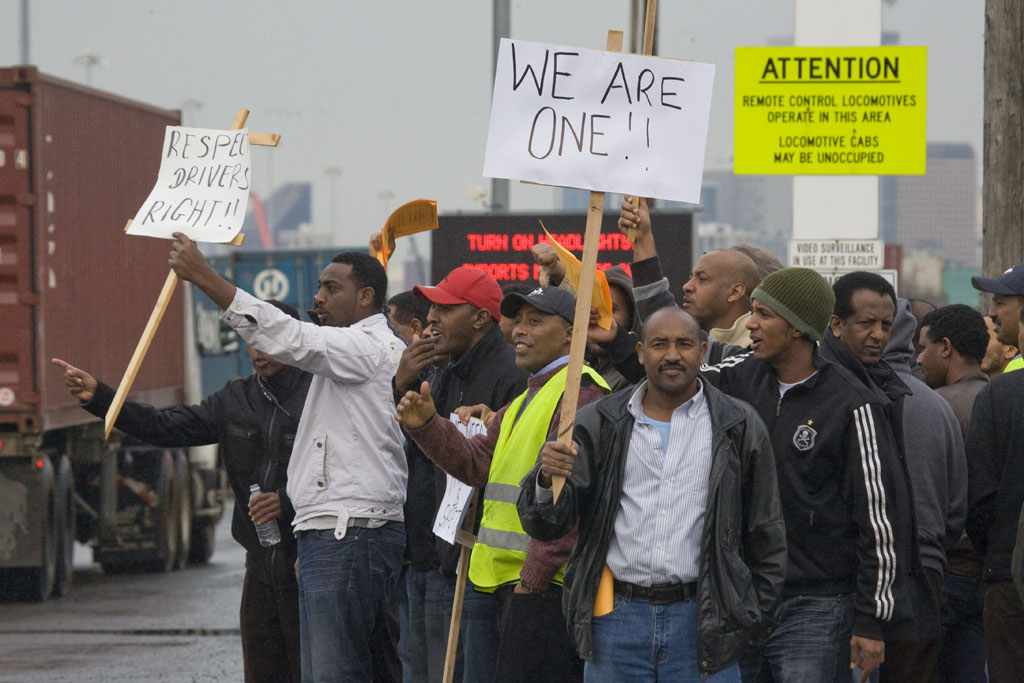
(Oakland, California – May 2, 2009) Today, the Port of Oakland presented its proposed “Comprehensive Truck Management Plan” to the public at Oakland City Hall. More than 100 people disrupted the meeting to voice their frustration that trucking industry legal challenges to the Southern California Ports’ Clean Trucks Plans has resulted in an Oakland Port plan that will not lead to sufficient air pollution reductions, working condition improvements and local job opportunities the community so desperately needs. Before marching out of the meeting in protest, independent Port truck drivers, environmentalists, environmental justice advocates, residents, faith leaders and union members delivered an Open Letter to the Port. The text of the letter follows:
Open Letter to the Port of Oakland Regarding proposed Truck Management Plan
Trucking Industry Legal Challenge to Air Clean-Up Plans Has Dire Public Health Consequences: The Port’s Not Holding Up its End of the Bargain
May 2, 2009
Dear Port of Oakland:
The Port’s proposed Truck Management Plan falls far short of the mark. Unfortunately, the so-called “Comprehensive Truck Management Plan” is anything but “comprehensive.” Nor is it sustainable. The plan fails to address the major labor problems in the port trucking system, and in so doing, continues to expose children, drivers, residents and workers to intolerably high health risks including asthma and cancer. We hold the trucking industry responsible for this situation in light of its vigorous legal challenge to the Southern California Ports’ Clean Trucks Programs. However, the Port can do a much better job of moving toward a comprehensive approach.
For the past two and a half years, our coalition of independent Port truck drivers and environmental, environmental justice, health, community, faith and labor organizations has been urging the Port of Oakland to adopt a comprehensive and sustainable policy to fix the broken port trucking system that is contributing to a public health crisis of asthma and cancer in neighboring communities and forcing Port truck drivers to toil in sweatshop working conditions. We participated in countless meetings and provided reams of information, scientific studies and sound public policy recommendations. But the product of this extensive and deliberative process falls far short of what is needed.
The California Air Resources Board port truck regulation is a good first step toward reducing port generated diesel truck pollution. Unfortunately, the trucking industry’s fight against taking responsibility for pollution clean-up, and the Port’s insufficient proposal endangers the health benefits of the CARB rule. The Port is not holding up its end of the bargain to implement workable policies to meet the CARB goals. The trucking industry, representing big businesses that have profited well from the current system, seems satisfied with placing the full burden of clean-up and health costs on independent drivers and community residents.
Come January, 2010, when the new standards are scheduled to go into effect, hundreds of port truck drivers — whose many years of experience and accumulated knowledge has been essential to the movement of goods in and out of the Port — could lose their livelihoods when their old trucks are no longer allowed to service the Port. The industry’s actions are unconscionable especially at a time when Oakland faces an unemployment rate nearing 16%. More people will become unemployed and the associated social problems will be exacerbated. It didn’t have to be this way.
Last month, the independent consulting firm, Beacon Economics completed an Economic Analysis at the request of the Port of Oakland. Beacon Economics strongly favors an employee driver-based Port trucking system to address critical inefficiencies, improve port security and meet upcoming air quality regulations. According to the Beacon study, as stronger emission requirements go into effect, the status quo is unlikely to be sustainable over the long-term without large and continual public subsidies and that an employee driver model dominates in regards to accountability, efficiency, and sustainability and in the long term will be easier to implement. The study further states that, “The movement towards a more employment-based system could enhance the efficiency of the current system, the ability to respond to pressing and future challenges, and the Port’s ability to grow.”
The Coalition for Clean & Safe Ports strongly supports the employee-based trucking system model, as well as a local hire program of training and job opportunities for residents in Port-impacted communities and support for small, local businesses that want to operate at the Port as essential ingredients in a comprehensive and sustainable Port trucking system. Unfortunately, these critical elements have been hampered by legal attacks from the trucking industry.
The trucking industry is battling the Southern California Ports’ Clean Trucks Programs which are on the way to reducing diesel truck pollution by 80%, delivering $5 billion to the regional economy, and creating stronger road safety and security enforcement. This irresponsible assault has serious ramifications for efforts to reform Oakland’s port trucking system at this time. Oakland Port staff has indicated that as long as the Southern California Ports’ Clean Trucks Programs are in legal limbo, the Port will not move forward on a Los Angeles-like plan as recommended by Beacon Economics.
While the Oakland Port’s option of a long-term comprehensive and sustainable solution has been obstructed at this time by the trucking industry’s legal challenges, in the short-term, the Port should adopt a policy that does not place the burden of air pollution clean up squarely on the shoulders of drivers and residents. The Port can, and must do better to develop viable solutions to protect our environment and the health and safety of residents and port workers.
Sincerely,
The Steering Committee of the Coalition for Clean & Safe Ports
Diane Bailey, Natural Resources Defense Council
Brian Beveridge, West Oakland Environmental Indicators Project
Doug Bloch, Change to Win
John Brauer, The Workforce Collaborative
Shirley Burnell, Oakland ACORN
Sharon Cornu, Alameda Labor Council, AFL-CIO
John Engstrom, East Bay Community Law Center
Kristi Laughlin, Interfaith Committee for Worker Justice
Chuck Mack, International Brotherhood of Teamsters
Swati Prakash, Pacific Institute
Aditi Vaidya, East Bay Alliance for a Sustainable Economy