
FOR IMMEDIATE RELEASE: October 1, 2009
CONTACT: Barb Maynard, 323-351-9321 ; Coral Lopez, 310-956-5712; Paul Karr, 917-208-5155
Environmental, Community and Labor Groups Nationwide Mark One-Year Success of Los Angeles Clean Truck Program
LOS ANGELES, CA – Having slashed deadly truck emissions by nearly 80 percent three years ahead of schedule, the Port of Los Angeles, under the leadership of Mayor Antonio Villaraigosa, has implemented what may be our nation’s most successful program ever for reducing heavy-duty truck pollution.
On the first anniversary of its Clean Truck Program, the City and Port of Los Angeles earned an outpouring of support from environmental, public health, community, labor and faith groups nationwide, many urging the U.S. Congress to stop an industry-backed legal attack designed to roll back LA’s progress and deter other ports from following suit.
“Congratulations to Southern California residents, environmentalists and truck drivers who fought for the Los Angeles Clean Truck Program and now breathe cleaner air one year later,” said Michael Green, the head of the Center for Environmental Health.
The Oakland-based group is among 28 organizations in Southern California, the Bay Area, Seattle, Newark, New York and even land-locked cities that today issued individual press statements praising LA’s unprecedented emissions-reductions and economic achievements, including:
- Banning over 2,000 of the dirtiest, oldest polluting rigs from port terminals
- Putting nearly 6,000 clean-burning vehicles into service
- Moving nearly 70 percent of cargo in low-emissions vehicles
- Boosting local truck sales by up to one-third, in contrast to a 60% national decline
- Leveraging over $500 million in private investment
Environmental advocates who want these benefits replicated at ports nationwide also used the occasion to sharply condemn the trucking industry polluters’ legal assault on the green-growth plan. Evidence suggests this has emboldened motor carriers to push the cost of new trucks onto the drivers, lowering their incomes.
“While there is a lot to celebrate today, the American Lung Association wants the focus to remain on long-term sustainability,” said Dr. Sonal Patel, a volunteer with the public health organization “Unfortunately, the benefits of cleaner trucks could be eroded by the American Trucking Association’s lawsuit to block critical pieces of the Clean Truck Program.”
To evade responsibility for cleaner commerce, the industry lobby argues that an arcane 20th century statute preempts critical components of both the LA Clean Truck Program and the weaker version in neighboring Long Beach.
Several groups also urged Congress to amend federal law to make it clear that local port officials can fully and legally implement the truck plan, which helps improve efficiency, port safety and security enforcement.
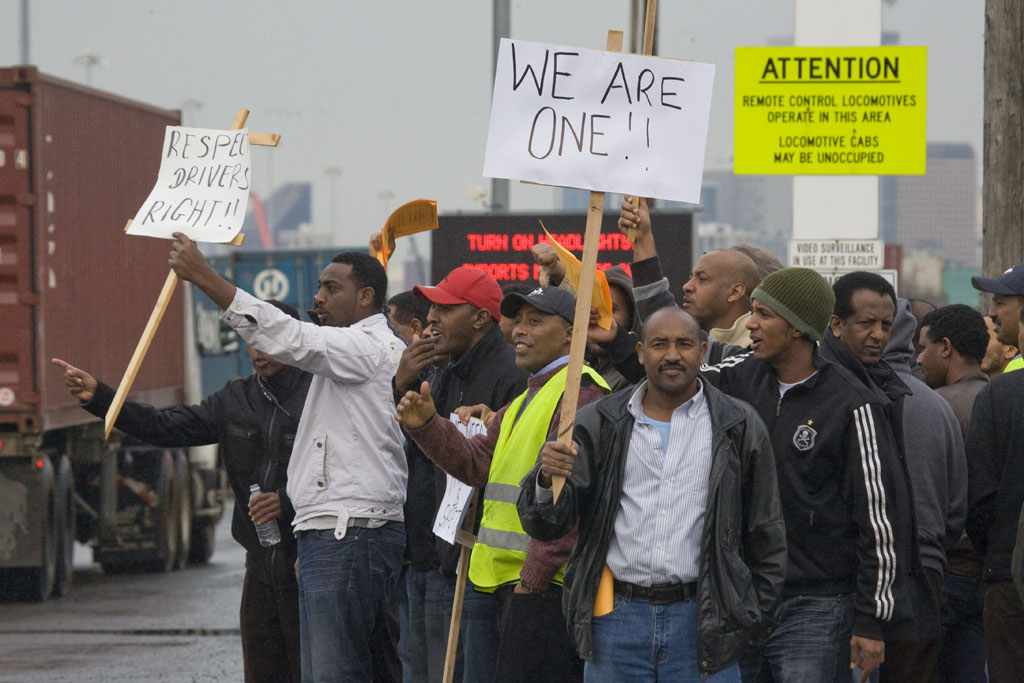
The clean-air plan’s opponents obtained a temporary injunction against key provisions which forces low-wage contract drivers to assume financial responsibility and maintenance of the clean-technology fleet, rather than capitalized trucking companies who hire them to haul goods out of the port.
As a recent Long Beach Press-Telegram story noted, “A severe downturn in trade since late 2007 coupled with stringent environmental regulations requiring drivers and companies to purchase new, ‘clean’ rigs have trimmed driver incomes to new lows, according to interviews with several local drivers.”
It quoted a port driver of nine years, Rafael Rivera, who recently went home with a $138 check after a week of hauling: “Between payments for the new truck, insurance, fuel, taxes and the lack of work, I’m barely making it…I’m working 18 hours a day, six days a week, and I still can’t afford my bills. I don’t know what’s going to happen.”
The head of a Seattle-based partnership of community, environmental, faith and civil rights groups sees Mr. Rivera’s story as direct cause of the stance of industry polluters.
“The American Trucking Association wants to shift the cost for pollution its companies create onto port workers and taxpayers, while communities closest to the Port suffer the consequences,” said David West, of Puget Sound Sage, which has advocated for the Northwest’s largest trade hub to follow LA’s approach in requiring profitable companies to take responsibility for the pollution they create.
Amy Goldsmith, the state director of the New Jersey Environmental Federation, saw it as another reason why Congress must update old law that fails to address 21st century challenges.
“We must have a federal framework that allows local port authorities to implement marketbased solutions to replicate LA’s clean-air successes on both coasts and create a levelplaying field for responsible business ready to compete and grow in a green economy.”
The group is part of a nationwide alliance of over 100 organizations known as the Coalition for Clean & Safe Ports on the West Coast, and the Coalition for Healthy Ports on the Eastern Seaboard. The direct link between pollution and poverty at our ports has united groups as diverse as the Natural Resources Defense Council, the Long Beach Alliance for Children with Asthma, the Teamsters, the American Lung Association of California, the Church Council of Greater Seattle, the Sierra Club, For a Better Bronx, and GreenFaith.
The Port Authority of New York & New Jersey and the Port of Oakland have joined the Port of Los Angeles to educate Congress about the tools they need to meet and sustain federal clean-air standards.