
FOR IMMEDIATE RELEASE: October 15, 2008
CONTACT: Barb Maynard, 323-351-9321 , [email protected]
New York & New Jersey Leaders Discuss New Plan to Clean Polluted Port Communities; Port Authority Looking Seriously at a Clean Trucks Program Similar to Port of Los Angeles
October 14, 2008 (New York) — Today, a panel of New York and New Jersey leaders, along with a representative of Los Angeles Mayor Antonio Villaraigosa (who was scheduled to attend but was unable to travel because of devastating wildfires raging in L.A.), participated in a lively discussion at the Drum Major Institute’s Marketplace of Ideas forum on the environmental and labor implications of a new policy agenda for cleaner ports. The panel included Congressman Jerrold Nadler (D-8) and Christopher Ward, Executive Director of the Port Authority of NY & NJ, as well as Kim Thompson-Gaddy, Co-Chair of the North Jersey Environmental Justice Alliance and a mother of three asthmatic children.
The current port trucking system in America is broken. Despite the enormous prosperity enjoyed by most participants in the global supply chain, American ports are where the oldest, most polluting trucks – owned by independent contractors at the bottom of the supply chain — finish out their years of service while polluting surrounding neighborhoods and causing elevated levels of asthma, cancer, and heart disease. Port trucking is dominated by tiny, fly-by-night brokers that contract with independent owner-operators. The brokers profit by undercutting market standards, creating an environmental crisis, inefficiency, congestion, and a race to the bottom.
Los Angeles Takes the Lead in Fixing the Broken Port Trucking System
On October 1, 2008, the Port of Los Angeles – with Mayor Villaraigosa’s leadership – was the first in the nation to take bold action to change the broken port trucking system by implementing the landmark Clean Trucks Program (CTP). Under this program, dirty diesel trucks servicing the twin ports of Los Angeles and Long Beach will be replaced with newer, cleaner-running models. The CTP requires that all trucks meet and maintain tougher 2007 federal emissions standards by 2012, with the aim of reducing emissions at the nation’s busiest cargo container complex by as much as 80 percent. The CTP is financed in part by a $35 fee per container.
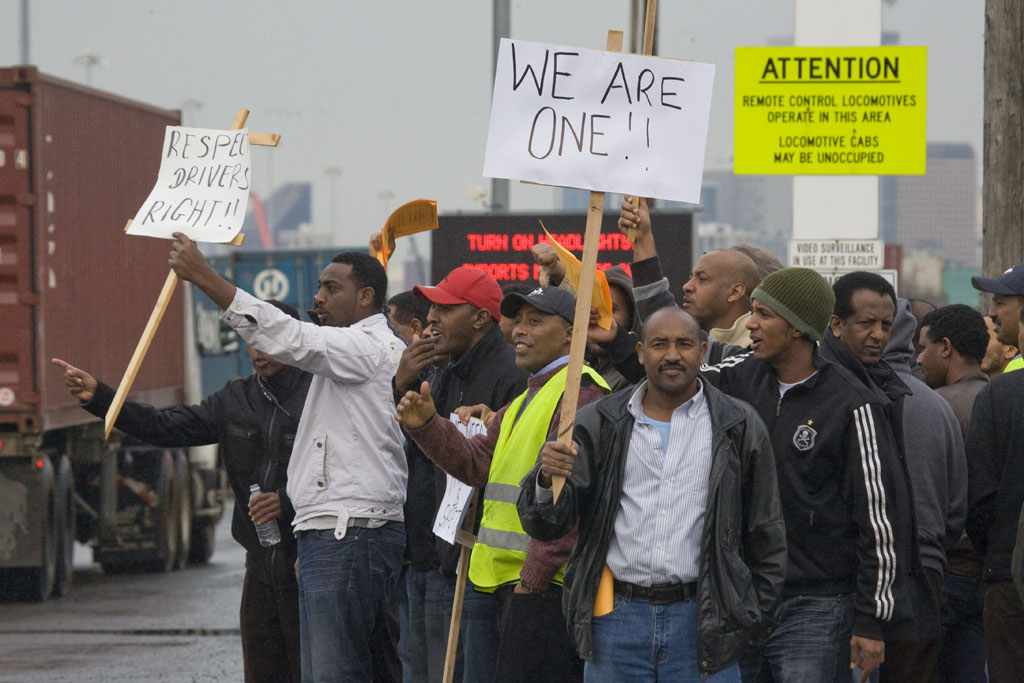
Critical to the success of the Los Angeles Clean Trucks Program is the requirement that trucking companies reclassify their so-called “independent” drivers – who are paid by the load but make on average just $10 an hour after expenses – as employees. As such, the trucking companies will be responsible for owning and maintaining the new-technology trucks. (Similar to the successful class action lawsuit that required that FedEx reclassify as employees its so-called “independent” drivers, California Attorney General Jerry Brown has filed a series of lawsuits against CA trucking companies for illegally misclassifying drivers as independent contractors.)
Port Authority of New York/New Jersey Called Upon to Set Standard for East Coast
Los Angeles is not alone in its urgent need to clean the air from diesel particulates. New Jerseyans face the nation’s second greatest cancer risk from diesel soot in the nation, and treatment for asthma alone accounts for 12 percent of New Jersey’s managed care costs. Newark’s school children experience a 25 percent asthma rate, double the state and national rates. (Source: “Diesel Hot Spots,” New Jersey Environmental Federation and Clean Water Fund, June 2006.)
“As a lifelong resident of Newark and a parent of three asthmatic kids, we’ve waited for change long enough,” said Kim Gaddy, an environmental justice organizer for the New Jersey Environmental Federation and Co-Chair of the New Jersey Environmental Justice Alliance, both of which are members of the Coalition for Clean Ports. “The pollution in our community is directly linked to the trucks that are coming on and off the ports. The Port of Los Angeles just launched a clean trucks program that promises to lower truck-related pollution by 80 percent. Residents of NY & New Jersey deserve the same relief from dirty diesel trucks.”
“The Port of Los Angeles has taken the first step in fixing our nation’s broken port trucking system. New York and New Jersey residents have had enough. The Port Authority should become the standard-setter for East Coast ports by adopting a clean trucks program. Port communities from around the country are coming together, along with environmental justice, public health, labor, and environmental advocates, to fix the broken port trucking system that is polluting our communities. The time for change at the Ports of New York and New Jersey is now.” — Amy Goldsmith, Chair, Coalition for Healthy Ports and State Director of the New Jersey Environmental Federation and the Clean Water Fund.
“Our Ports are a critical part of our region’s economic health but should not harm our families’ health. We can grow our ports while protecting our environment and our families but it takes real leadership from government.” — Jeff Tittel, Director, NJ Sierra Club.
“Through massive amounts of air pollution, Port Newark is one of the biggest environmental health threats in the greater New York area, harming the health of residents of Newark and surrounding communities. Better alternatives exist. The Port needs to take steps now to clean up their operations – for the wellbeing of the community and the environment.” — The Rev. Fletcher Harper, Executive Director, GreenFaith.
“Exit 8A of the New Jersey Turnpike has transformed our Garden State into our Warehouse Depot State. How far will we let Port Newark boundaries extend, infecting our lives and those – like the truckers who are treated unfairly serving its global interest – without raising quality of life issues regarding pollution, fair employment practices, and the loss of green space?” — Rev. Geoffrey Curtiss, All Saints Episcopal Parish, Hoboken, NJ