
FOR IMMEDIATE RELEASE: April 15, 2009
CONTACT: Coral Lopez, 310-956-5712; Barb Maynard, 323-351-9321
Public Health is No 1, Says U.S. District Judge in Denial of FMC Motion to Shelve the LA-LB Clean Trucks Programs
Coalition for Clean & Safe Ports Calls on Members of Congress to Protect Port Green-Growth Policy that will Save Lives, Improve Safety & Security
LOS ANGELES and WASHINGTON, DC – In a victory for the movement to clean the air and create good green jobs at our nation’s ports, over 80 organizations united in the Coalition for Clean & Safe Ports in California celebrated U.S. District Judge Richard J. Leon’s denial of the Federal Maritime Commission’s (FMC) motion for a preliminary injunction that would have threatened the San Pedro Bay Ports’ Clean Trucks Programs.
Judge Leon’s denial was based on the federal agency’s failure to demonstrate that the LA and Long Beach Ports’ differing “concession” models would cause irreparable harm to – or create anti-competitive conditions for – the goods movement industry. The Clean Trucks Programs aim to reduce diesel truck pollution by 80%, deliver $5 billion to the regional economy, and create stronger safety and security enforcement. If successful, the initiatives will help clear a pathway to job-creating future port expansion projects.
The FMC has the ability to take action against agreements in the ocean shipping industry that it believes are likely by a reduction in competition to unreasonably raise rates and decrease services, but Judge Leon (appointed by George W Bush), in his opinion, noted the Ports “are implementing ambitious, multi-faceted programs to reduce high levels of air pollution while also striving to improve the Ports’ safety and security and to enable future development….Given the protracted and public deliberative process that led to the development of the CTPs and the responsibility the [Ports] have for improving the area’s public health and managing the Ports’ efficient operations, the Court finds that the public interest, at this point, favors denying the FMC’s motion” for a preliminary injunction.
“Protecting the public health is at the heart of this program, and it is paramount to all other concerns,” said David Pettit, Director of the Southern California Air Program for the Natural Resources Defense Council. “All Californians should appreciate that a court on the other side of the country recognized our need to get these dirty trucks off the road once and for all. The only way to do that is to make well-capitalized companies – not low-wage workers – responsible for a new, clean-burning fleet.”
The opinion comes just as the Los Angeles Times today reported that a broad public health, environmental, community, labor and faith-based coalition has called on Members of Congress to continue to help protect the Los Angeles model for port trucking nationwide. The blue-green alliance is bracing for the possibility that industry clean-air opponents that brought a separate suit may succeed in creating roadblocks to the life-saving programs in a Los Angeles court on April 27.
The LA policy requires trucking firms to apply for concessions and take responsibility for new vehicles by legitimately employing their drivers. The comprehensive policy also includes generous subsidies funded by cargo container fees for truck purchases, along with powerful incentives that will help get alternative fuel trucks on the road quicker and jump start a new market. The Long Beach Port also relies on a concession plan, but has come under fire by environmental groups because the burden of replacing some 16,000 old diesel trucks remains on the backs of individual “independent” haulers who average $29,000 a year, rather than companies who are in a financial position to replace and properly maintain clean-fuel trucks.
The nation’s largest trucking lobby opposes both plans, and successfully argued to a 9th Circuit Court of Appeals panel that their desire to maintain a deregulated industry outweighs the public interest in clean air that Judge Leon relies on in his opinion. Despite the Virginia-based American Trucking Association’s maneuvering, many of its local and national members, comprised of nearly 1,000 trucking companies large and small applied to become concessionaires and have purchased thousands of trucks, signaling a readiness to grow in an asset-based market.
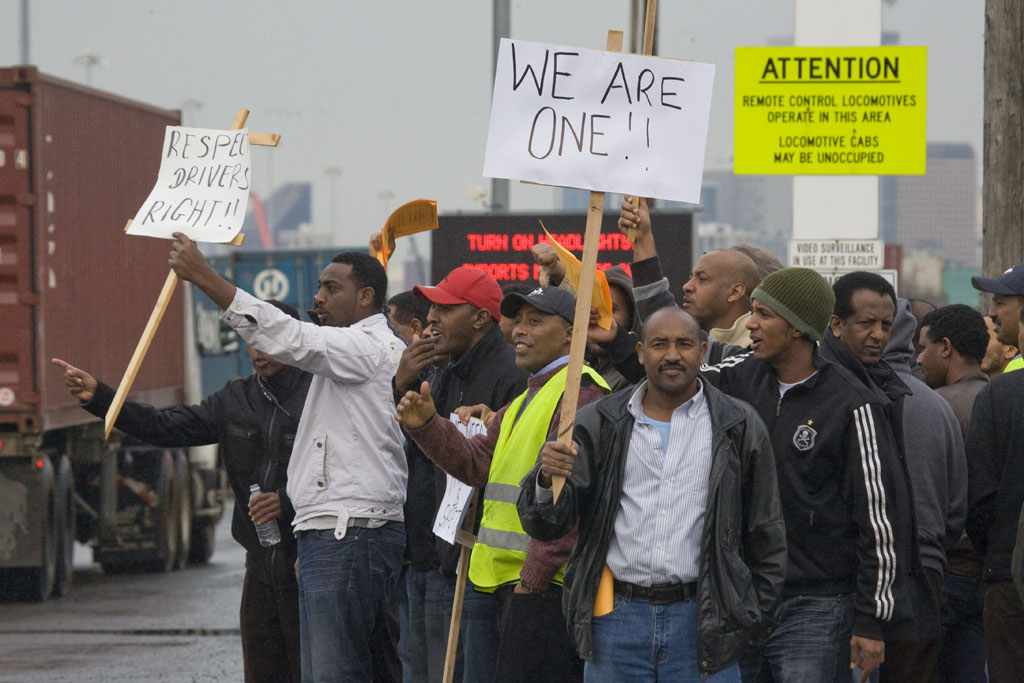
“Diesel kills people in my neighborhood each and every week,” said Bismark Sanchez Jr, a harbor-area resident. “As a father and a port truck driver, I am happy this judge ruled that my city’s clean-air program is legal. But I’m scared that the hired guns at the American Trucking Association want another court to allow the industry to go on polluting.”
Last winter, local residents and members of the over 80 national, state and local organizations comprising the Coalition for Clean & Safe Ports generated over 10,000 emails and postcards to Members of Congress representing pollution-affected regions surrounding the LA, Long Beach and Oakland ports. They urged their representatives to review the obstructionist actions of the FMC, and called on their elected leaders to help appoint new commissioners that share President Barack Obama’s commitment to the environmentally and economically sound LA Clean Trucks Program.
Speaker of the House Nancy Pelosi, along with Senators Boxer, Feinstein and the entire Democratic California delegation to Congress have each written to the FMC, urging it not to overstep its jurisdiction by interfering with a program that would “actually strengthen competition within the port trucking industry as well as between port trucking and their retail clients. Since port trucking costs are a relatively small component of overall transportation costs, the increased operational costs required by this program will be far outweighed by the overwhelming public benefits.”
Environmentalists, residents and port drivers in other cities who have mounted a similar effort in their communities to enact an LA style comprehensive clean-up policy want Members of Congress to examine how the deregulation of port trucking, like that of the financial sector, has been a disaster for highway safety, air quality, and on job quality.